
Dynamic vs. Static Wrinkles & Microtox | AdoreU
Dynamic vs. Static Wrinkles: How Wrinkle Relaxers Actually Work
Wrinkles do not all form for the same reason—and they do not all respond to the same treatment.
Some lines appear only when you smile, squint, frown, or raise your eyebrows. Others remain visible even when your face is completely relaxed. Understanding the difference between dynamic and static wrinkles helps explain what wrinkle relaxers such as DAXXIFY, Botox, Dysport, and Xeomin can realistically accomplish.
Wrinkle relaxers can reduce the muscle activity that repeatedly folds the skin, but they do not fill a crease or instantly repair changes that have already developed within the skin.
That distinction matters when creating a treatment plan and setting realistic expectations.
What Is a Wrinkle?
A wrinkle is a line, fold, or crease that develops in the skin.
Facial expression is one part of the process. Every time you frown, squint, smile, raise your eyebrows, or purse your lips, the muscles beneath your skin contract. Those muscles pull on the skin and repeatedly fold it in predictable places.
When we are younger, the skin generally smooths back out once the expression stops. As the skin changes with age, it may not rebound as easily.
Several factors can contribute to the development of visible wrinkles, including:
Repetitive facial movement
Gradual loss of collagen and elastin
Changes in skin thickness and hydration
Sun exposure
Genetics
Smoking
Environmental exposure
Hormonal changes
The natural aging process
This is why treating wrinkles is not always as simple as placing an injection directly underneath a visible line.
What Are Dynamic Wrinkles?
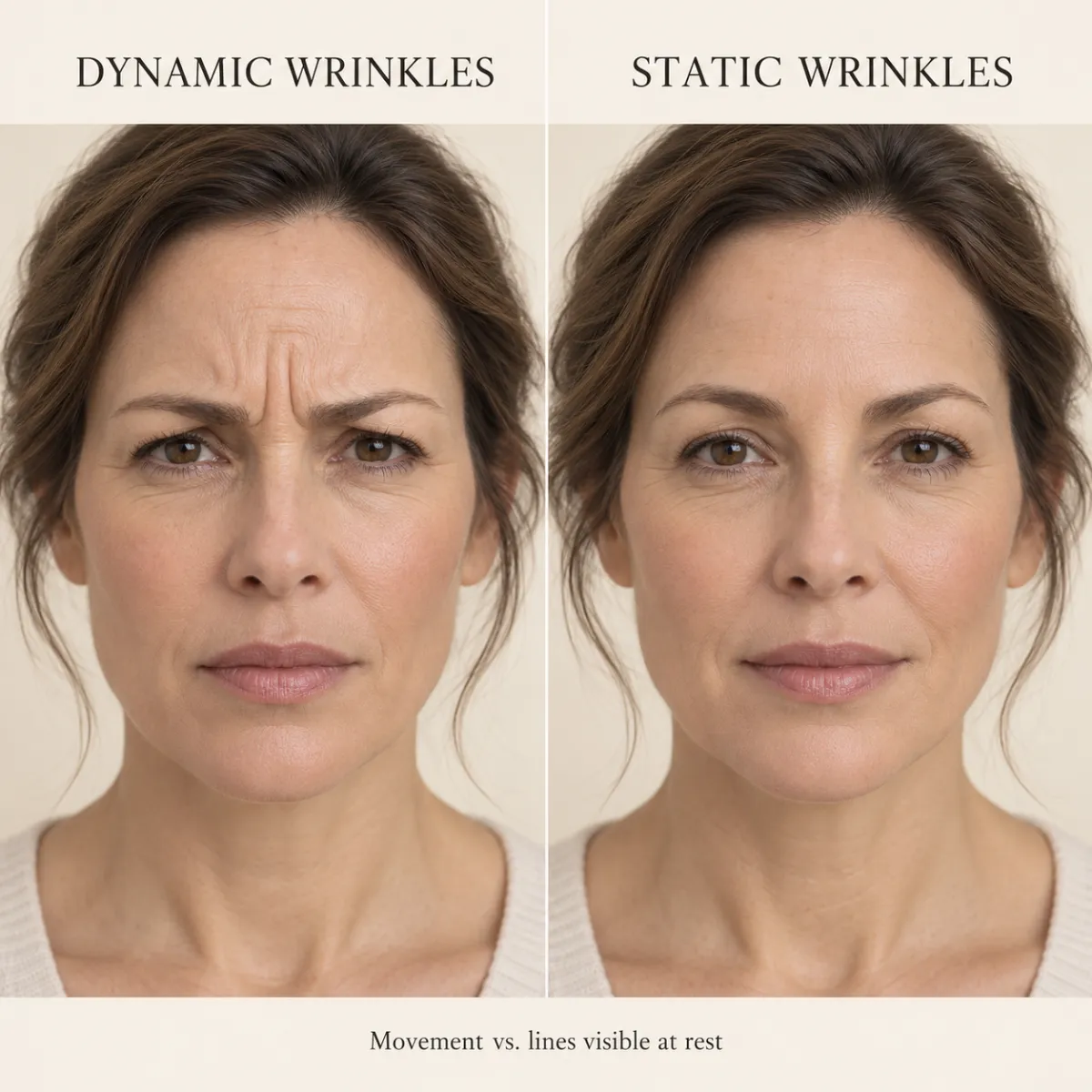
Dynamic wrinkles are lines that appear or become more noticeable when a facial muscle contracts.
Examples include:
Horizontal forehead lines when you raise your eyebrows
Frown lines between the eyebrows
Crow’s feet when you smile or squint
Bunny lines along the sides of the nose
Lip lines that appear when you purse your lips
Chin dimpling caused by contraction of the mentalis muscle
If the line disappears when your face relaxes, it is primarily dynamic.
These wrinkles are created by movement, which is why they tend to respond well to neuromodulators. By reducing the contraction of the muscle responsible for folding the skin, we can soften the line when the face is moving.
What Are Static Wrinkles?
Static wrinkles remain visible when the face is at rest.
A dynamic wrinkle can gradually become a static wrinkle after the skin has been repeatedly folded in the same location over many years. Changes in collagen, elasticity, skin thickness, hydration, and sun damage can make the crease more likely to remain visible.
You may still see the line even when you are not frowning, smiling, squinting, or raising your eyebrows.
Examples can include:
Frown lines that remain between the eyebrows at rest
Forehead lines visible without raising the eyebrows
Crow’s feet present without smiling
Established lines around the mouth
Deeper creases that no longer disappear when movement stops
Static wrinkles may still improve with wrinkle-relaxer treatment, but they usually require more time—and sometimes more than one type of treatment.
How Do Wrinkle Relaxers Work?
DAXXIFY, Botox, Dysport, and Xeomin are prescription neuromodulators made with different formulations of botulinum toxin type A.
These medications temporarily reduce the release of acetylcholine, the chemical messenger that tells a muscle to contract.
When the targeted muscle cannot contract as strongly, it does not pull and fold the overlying skin as aggressively. This can soften dynamic wrinkles and reduce the repetitive movement that contributes to those lines becoming more deeply etched over time.
Wrinkle relaxers do not add volume, fill a crease, or physically remove a wrinkle. They change the muscle activity contributing to the wrinkle.
Why Injection Placement Matters
I do not simply look at a line and inject directly underneath it.
I watch how your face moves and determine which muscle is creating the movement that produces the line. I also consider the surrounding muscles and how they work together.
Facial muscles frequently pull in opposing directions. Weakening one muscle can change the balance of another, which is why precise assessment and placement matter.
During Treatment Planning, I evaluate:
Your facial anatomy
The size and strength of each muscle
How your muscles move together
Eyebrow position and natural facial balance
Which lines appear during movement
Which lines remain visible at rest
Previous neuromodulator treatments and responses
How much movement you want to maintain
Your treatment priorities and budget
The goal is not to chase every visible line or make every face expressionless. The goal is to identify the muscles creating the unwanted movement and treat them thoughtfully while preserving appropriate function and facial balance.
Will a Wrinkle Relaxer Erase a Static Wrinkle?
Not necessarily—and certainly not overnight.
If a wrinkle is already visible when your face is completely relaxed, reducing the underlying movement can prevent the skin from being folded as forcefully in the same location. This may allow the line to soften gradually.
However, relaxing the muscle does not instantly rebuild collagen, restore elasticity, or erase an established crease in the skin.
Improving static wrinkles may involve:
Consistent neuromodulator treatment
Daily broad-spectrum sunscreen
Medical-grade skincare
Retinoids or other collagen-supporting ingredients when appropriate
Microneedling
RF microneedling
Laser resurfacing
Chemical peels
Other treatments selected for the condition of the skin
The best approach depends on the depth of the line, the quality of the skin, the muscle activity underneath it, and your goals.
Why Do I Still Have Lines After My Wrinkle Relaxer Treatment?
Seeing a remaining line does not automatically mean your treatment failed.
The muscle may be appropriately relaxed while a crease remains within the skin. Think of a piece of fabric that has been folded repeatedly in the same place: removing the force creating the fold does not immediately remove the crease that has already formed.
It also takes time for a neuromodulator to reach its full effect. Some people begin noticing a change within the first few days, but the result should generally be evaluated at approximately 14 days.
If the muscle is still contracting strongly after that point, the dose or placement may need to be reassessed. If the muscle is relaxed but the line remains visible, the concern may be more about skin quality than persistent muscle movement.
Those are two different problems and may require different treatment strategies.
Can Wrinkle Relaxers Help Prevent Deeper Lines?
Reducing repeated muscle contraction may help prevent a dynamic line from becoming more deeply established.
This does not mean everyone needs to begin treatment at a particular age. There is no universal “right” age to start wrinkle relaxers.
The decision should be based on:
Your movement patterns
Whether lines are beginning to remain at rest
Your personal preferences
Your treatment goals
The amount of movement you want to preserve
Whether ongoing treatment fits your priorities
Preventive treatment should still be individualized. More medication is not automatically better, and a completely frozen appearance is not required to reduce repetitive folding.
What Is Microtox?
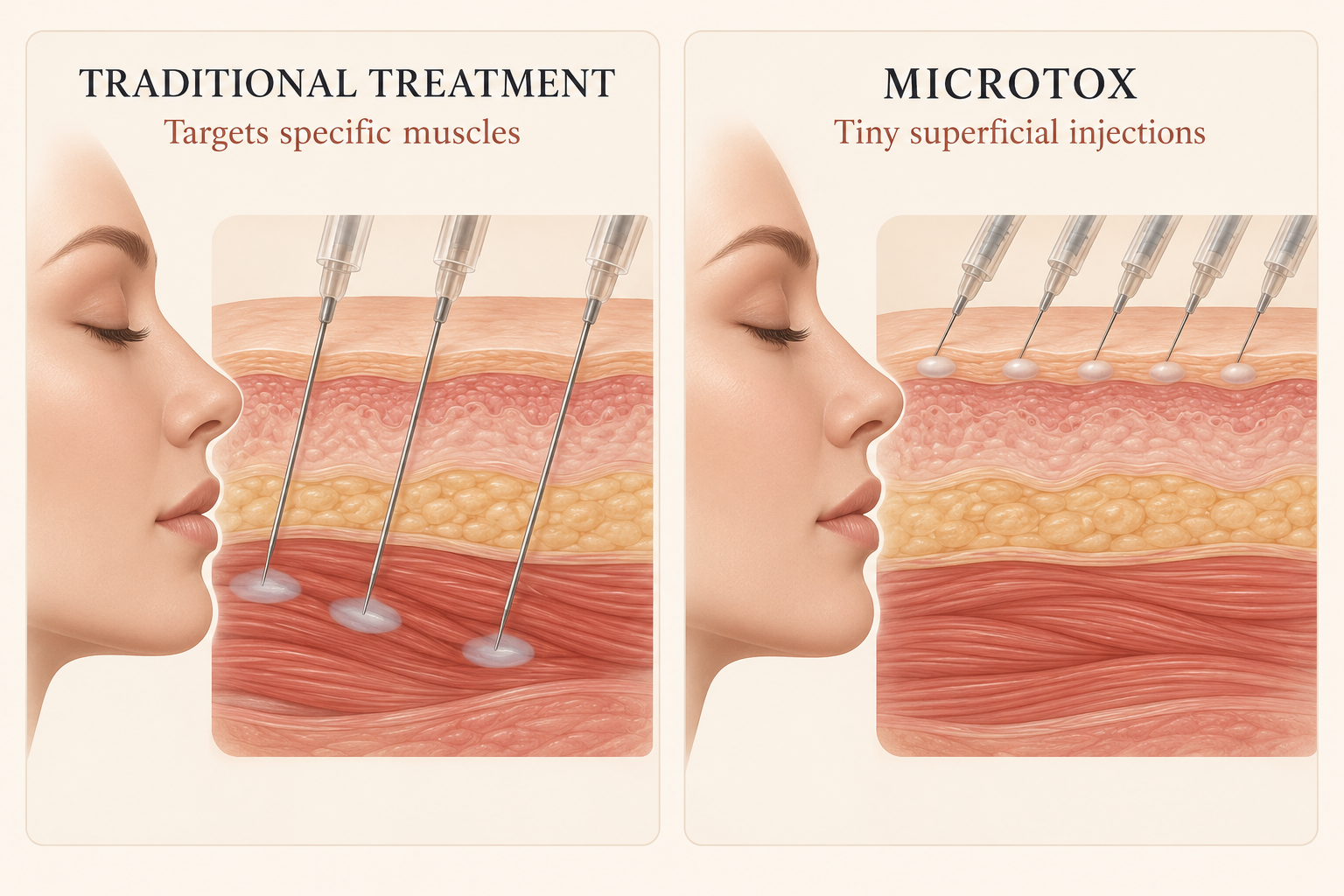
Traditional wrinkle-relaxer injections are generally placed into specific facial muscles to reduce the muscle contractions responsible for dynamic wrinkles.
Microtox uses a different technique.
With Microtox, very small amounts of diluted neuromodulator are distributed through multiple tiny injections placed much more superficially—typically within the skin or immediately beneath it—rather than using only deeper injections intended to target an entire muscle.
The goal is generally a more superficial and subtle effect.
Depending on the treatment area and technique, Microtox may affect structures within the skin and the most superficial muscle fibers while preserving more of the deeper muscle function.
What Can Microtox Treat?
Research into intradermal botulinum toxin suggests that Microtox techniques may help improve concerns such as:
Very fine lines
Crepey skin texture
The appearance of enlarged pores
Excess oil or sebum production
Certain areas of facial redness
Fine lines along the face, jawline, or neck
Subtle skin smoothing
Microtox is not simply a lighter version of a traditional wrinkle-relaxer treatment. It uses a different injection depth, distribution pattern, concentration, and treatment goal.
The research is promising, but Microtox protocols are not standardized. Studies have used different products, doses, dilutions, injection depths, and treatment patterns. Results can therefore vary, and the technique should not be presented as a guaranteed solution for every skin concern.
Microtox vs. Traditional Wrinkle-Relaxer Injections
Traditional neuromodulator treatment
Traditional treatment generally:
Targets one or more specific facial muscles
Uses strategically placed intramuscular injections
Focuses on reducing the contractions that create dynamic wrinkles
Is commonly used for frown lines, forehead lines, and crow’s feet
Uses a dose based heavily on muscle size, strength, anatomy, and treatment goals
Microtox treatment
Microtox generally:
Uses many tiny, superficial injections
Distributes small amounts across a treatment area
Focuses on a more superficial effect
May be considered for fine lines, texture, pores, oil production, or certain areas of redness
May affect superficial muscle fibers while preserving more movement in the deeper muscle
Microtox is not automatically better than traditional neuromodulator treatment. They are different techniques designed for different concerns.
Sometimes the goal is to relax a specific muscle. Sometimes the goal is to create a more subtle effect within the skin and superficial tissues. In some treatment plans, the two approaches may be used in different areas.
Is Microtox the Same as Baby Botox?
Not exactly.
“Baby Botox” is an informal term commonly used to describe a lower-dose traditional neuromodulator treatment. The injections may still be placed into the facial muscles, but fewer units are used to create a lighter effect and preserve more movement.
Microtox refers more specifically to the superficial placement and distribution technique.
Both approaches may use smaller amounts of medication, but the injection depth and treatment goal are not necessarily the same.
Which Treatment Is Right for Your Wrinkles?
The right treatment depends on what is creating the concern.
If the line appears primarily during facial movement, targeting the responsible muscle may provide the greatest improvement.
If the wrinkle remains visible at rest, reducing movement may be one part of the plan, but improving the skin itself may also be necessary.
If the concern involves very fine lines, pores, oil production, or superficial texture, Microtox may be considered depending on the treatment area and your goals.
In many cases, the most effective plan combines treatments that address different parts of the aging process:
Neuromodulators for excessive muscle movement
Skincare and sunscreen for daily protection and repair
Microneedling or RF microneedling for collagen support
Laser treatments for tone, texture, and sun damage
Resurfacing treatments for more established skin changes
Volume-restoring treatments when volume loss contributes to the concern
Not every line needs to be treated, and not every client needs every type of treatment.
Individualized Wrinkle Treatment at AdoreU
At AdoreU, your treatment begins with Treatment Planning.
I evaluate your face while it is relaxed and while it is moving. We discuss what bothers you, what you want to preserve, how you responded to previous treatments, and what outcome would feel right for you.
I do not use the same number of units or the same injection pattern for every client. Your anatomy, muscle strength, movement, skin quality, goals, and budget all help shape the plan.
The goal is not to make you look like someone else. It is to soften the concerns that bother you while keeping the result balanced and appropriate for your face.
Learn more about aesthetic treatments at AdoreU, or call or text 636-486-6770 to request a Treatment Planning appointment in O’Fallon, Missouri.
Individual results vary. This article is intended for educational purposes and does not replace individualized medical guidance.
Frequently Asked Questions
What is the difference between dynamic and static wrinkles?
Dynamic wrinkles appear when facial muscles move. Static wrinkles remain visible when the face is relaxed. A dynamic line may become static after years of repetitive movement combined with changes in collagen, elasticity, and skin quality.
Will a wrinkle relaxer remove wrinkles that are visible at rest?
It may gradually soften them by reducing the movement that repeatedly folds the skin, but it does not instantly erase an established crease. Skincare, sun protection, collagen-supporting treatments, or resurfacing procedures may also be appropriate.
Why can I still see a line if the muscle is no longer moving?
The treatment may have successfully relaxed the muscle while an established crease remains within the skin. Muscle movement and skin quality are related, but they are not the same concern.
Is Microtox injected into the muscle?
Microtox is generally placed much more superficially—within the skin or immediately beneath it—rather than using only the deeper intramuscular placement associated with traditional neuromodulator treatment. It may still affect superficial muscle fibers through diffusion.
Is Microtox the same as Baby Botox?
No. Baby Botox usually refers to using a lower dose for a lighter traditional neuromodulator treatment. Microtox describes a superficial microdroplet injection technique. The terms are sometimes used loosely, but they do not technically describe the same approach.
Can Microtox improve pores and skin texture?
Research suggests that intradermal botulinum toxin may improve the appearance of pores, oil production, fine lines, and certain texture concerns. However, techniques and study protocols vary, so results cannot be guaranteed.
How long does Microtox last?
Duration varies based on the product, dose, dilution, treatment area, technique, and individual response. Microtox should not automatically be expected to last as long as a traditional muscle-targeted treatment.