
Testosterone Benefits for Women & Men: What You Need to Know | AdoreU
The Real Benefits of Optimizing Testosterone
When people hear the word testosterone, they often think of sex drive.
And yes, testosterone plays an important role in sexual health.
But that is only one piece of the picture.
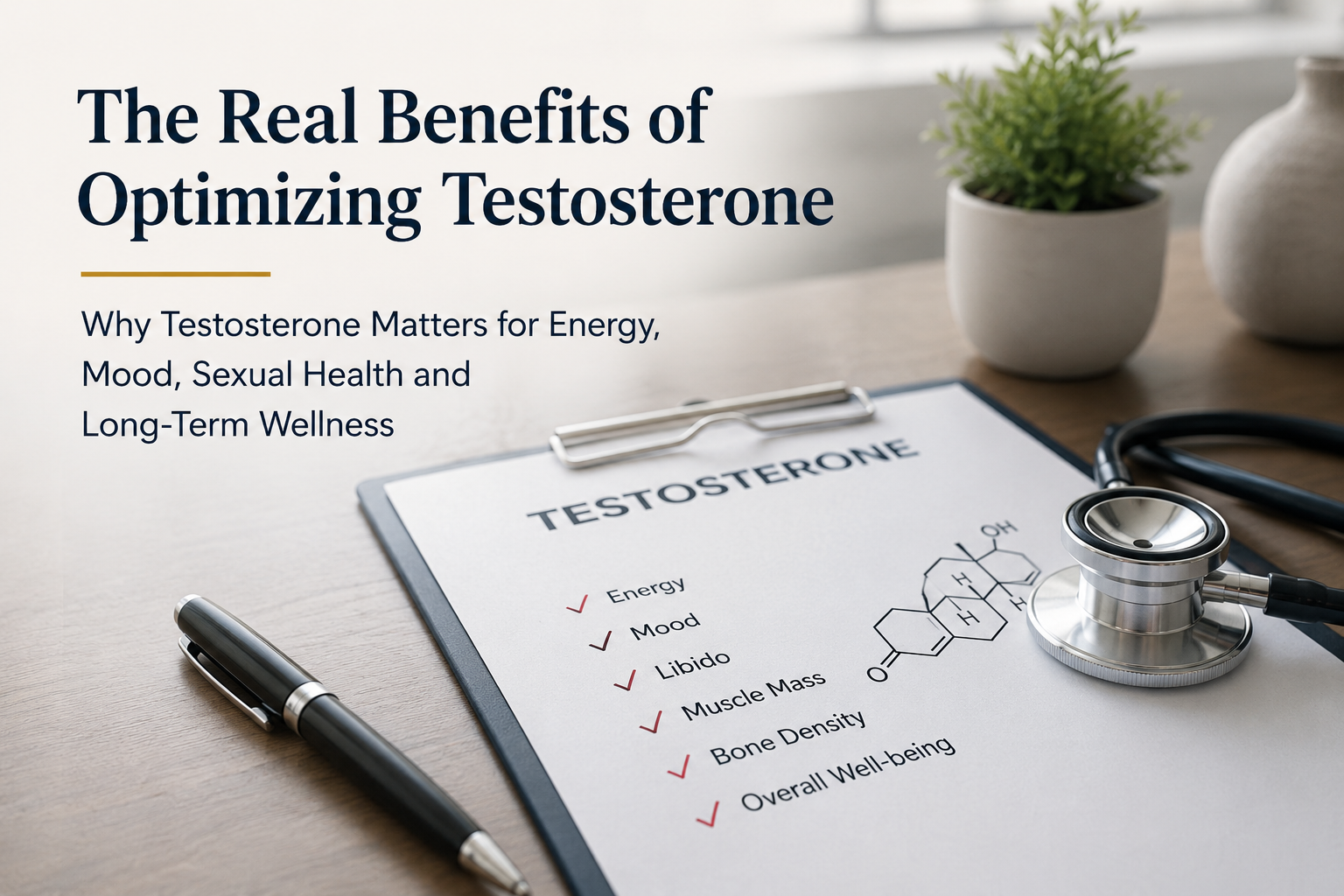
Testosterone has receptors throughout the body and is involved in many systems that influence how we feel and function — including muscle, bone, body composition, mood, energy and sexual health.
That is true for both men and women.
At AdoreU, the goal of testosterone therapy is not to chase the highest possible number or make everyone fit the same laboratory range.
The goal is to determine whether testosterone is clinically appropriate, understand your symptoms and laboratory findings together, and then monitor how your individual body responds.
Testosterone Is Not Just a “Male Hormone”
Women naturally produce testosterone too.
In fact, testosterone is one of several hormones that can influence a woman’s sense of well-being, sexual function, muscle, bone and body composition.
In women, testosterone is produced by the ovaries and adrenal glands and can also be formed through conversion of other hormones.
Men generally have much higher testosterone concentrations, but testosterone remains physiologically important in both sexes.
Research has identified androgen receptors throughout tissues including the brain, skin, bone, adipose tissue and vascular system.
So while libido gets most of the attention, testosterone is doing considerably more behind the scenes.
Testosterone and Sexual Health
This is the benefit most people already know about.
For men with testosterone deficiency, testosterone therapy has been shown to improve sexual desire and may improve erectile function and sexual activity in appropriately selected patients.
Testosterone also plays a role in female sexual function.
Research in women has examined testosterone therapy for concerns such as reduced sexual desire and arousal, particularly after menopause or surgical menopause.
But sexual health is highly individual.
Low libido can also be influenced by:
estrogen changes
vaginal discomfort
medications
stress
poor sleep
relationship factors
mood
thyroid dysfunction
metabolic health
other medical conditions
That is why I do not automatically assume every libido concern is simply a testosterone problem.
Testosterone and Muscle
Testosterone is an anabolic hormone, meaning it plays an important role in maintaining muscle tissue.
In men with testosterone deficiency, clinical trials have demonstrated improvements in lean body mass with testosterone therapy.
This becomes especially relevant as we age.
Muscle is not just about looking fit.
Maintaining muscle supports:
strength
mobility
metabolic health
glucose regulation
physical function
healthy aging
That does not mean testosterone replaces resistance training.
Quite the opposite.
Hormones, adequate protein intake and strength training work together.
If someone is receiving hormone therapy but sleeping poorly, eating inadequately and never challenging their muscles, medication alone cannot do all the work.
Testosterone and Body Composition
Changes in body composition are another reason some patients begin wondering about their hormones.
They may notice:
more abdominal fat
difficulty maintaining muscle
decreased strength
reduced exercise recovery
weight redistribution despite similar habits
Testosterone therapy has been associated with increased lean mass and reduced fat mass in testosterone-deficient men.
But body composition is influenced by much more than testosterone.
Insulin resistance, thyroid function, calorie intake, sleep, stress, alcohol intake, activity level and muscle mass all contribute.
Sometimes hormones are part of the answer.
Sometimes metabolic health is the bigger issue.
Often we need to look at both.
Testosterone and Bone Health
This is one of the most overlooked roles of sex hormones.
Bone is living tissue.
It is constantly being broken down and rebuilt, and sex hormones play an important role in that process.
Testosterone therapy has been shown to improve bone density in men with testosterone deficiency.
But there is another important piece to understand:
Men need estrogen too.
Some testosterone is converted into estradiol through the enzyme aromatase.
Research in older men has found that lower bioavailable estradiol is associated with greater deterioration in bone microarchitecture over time.
So the goal in men is not necessarily to drive estrogen as low as possible.
Healthy hormone physiology depends on balance.
Testosterone, Energy and Motivation
This is where expectations need to stay realistic.
Patients often come in saying:
“I’m exhausted.”
“I have no drive.”
“I don’t feel motivated anymore.”
“I just don’t feel like myself.”
Testosterone deficiency can overlap with those symptoms, and some studies have reported improvements in energy, mood and sense of well-being with therapy.
But fatigue is one of the least specific symptoms in medicine.
It can also be associated with:
poor sleep
sleep apnea
thyroid dysfunction
iron deficiency
nutrient deficiencies
chronic stress
metabolic disease
medications
depression or anxiety
autoimmune conditions
inadequate nutrition
overtraining or underactivity
So while testosterone may be part of the picture, I do not promise that correcting one hormone will suddenly fix every symptom.
Testosterone and Mood
Hormones and the brain are connected.
Androgen receptors are present within the central nervous system, and testosterone has been studied for its relationship with mood, cognition, motivation and overall well-being.
A study of women receiving testosterone implants reported improvements across psychological, somatic and urogenital symptom scores over three months.
However, mood is complex.
Hormones should never be used as a blanket explanation for depression, anxiety or significant changes in mental health.
Instead, hormone status can be considered as one potential contributor within the larger clinical picture.
More Testosterone Is Not Automatically Better
This may be one of the most important parts of testosterone therapy.
The objective is not:
“Let’s get your testosterone as high as possible.”
Hormone therapy is individualized.
Symptoms matter.
Laboratory findings matter.
Side effects matter.
Your health history matters.
And how your body metabolizes and responds to treatment matters.
Even expert consensus regarding testosterone deficiency in men recognizes that there is not one testosterone concentration that reliably predicts who will experience symptoms or exactly who will respond to treatment.
That is why I am cautious about universal “optimal ranges” circulating on social media.
A number that works well for one person is not automatically the right target for another.
SHBG Changes the Picture Too
Total testosterone is not the only number I consider.
Sex hormone-binding globulin, or SHBG, influences how much testosterone is bound in the bloodstream and how much may be biologically available.
Two people can have very similar total testosterone levels but very different free or bioavailable testosterone depending partly on their SHBG.
The testosterone literature also recognizes limitations in androgen assays, differences among laboratory reference ranges and the importance of considering symptoms alongside laboratory measurements.
This is exactly why hormone evaluation cannot be reduced to one highlighted number on a lab report.
Your Body Has to Metabolize Testosterone Too
Testosterone does not simply circulate unchanged and perform one job.
It can be converted into other hormones and metabolites.
For example:
Testosterone → estradiol
through the enzyme aromatase.
And:
Testosterone → dihydrotestosterone (DHT)
through 5-alpha reductase.
Those pathways can differ from person to person.
One individual may convert more testosterone toward DHT.
Another may aromatize more testosterone into estradiol.
That is another reason the same testosterone dose can produce very different laboratory results, benefits or side effects between two patients.
Testosterone Therapy for Women and Men Is Not Identical
Although testosterone is important in both sexes, treatment is not simply the same protocol with different doses.
Women and men have different physiologic hormone environments, treatment goals, laboratory patterns and monitoring needs.
A woman in perimenopause may also need evaluation of estrogen and progesterone.
A man receiving testosterone therapy may require monitoring of estradiol, hematocrit, PSA when appropriate and other health markers.
The plan should be built around the individual — not around a prepackaged protocol.
Why I Prefer Pellet Therapy for Many Patients
When testosterone therapy is appropriate, there are several potential delivery methods.
These may include:
injections
topical preparations
compounded therapies
subcutaneous pellets
At AdoreU, hormone pellet therapy is my preferred delivery method for many women and men.
Pellets provide sustained hormone delivery without requiring a daily application or frequent injections.
That does not mean pellets are automatically the right choice for every patient.
Treatment decisions still depend on health history, symptoms, laboratory findings, goals and individual response.
Treatment Is Only One Layer
This is where hormone optimization gets very different from simply writing a prescription.
If someone is not sleeping, chronically stressed, metabolically unhealthy, sedentary, undernourished or dealing with another medical issue, testosterone cannot magically override all of that.
We may need to address:
hormones
sleep
stress
exercise
muscle preservation
metabolic health
nutrition
thyroid function
gut health
autoimmune or inflammatory conditions
other medical concerns
Sometimes hormone therapy makes a significant difference.
Sometimes we need a layered approach before someone really starts feeling better.
What Testosterone Evaluation Looks Like at AdoreU
Initial Evaluation + Lab Draw
Your first visit begins with a conversation.
We discuss your symptoms, health history, previous treatment and what you hope to improve.
Then we determine which laboratory testing makes sense and draw your initial labs.
Results Review + Treatment Planning
Once your results are available, you return for a comprehensive review.
We go through the results together and connect them with your symptoms, health history and goals.
If testosterone or other hormone therapy is appropriate, we discuss your options and develop the treatment plan together.
Treatment + Monitoring
After treatment begins, we continue monitoring.
Your symptoms, laboratory trends, side effects and response help determine whether the plan remains appropriate or needs to change.
Because good hormone care should evolve with the patient.
The Bottom Line
Testosterone is about far more than libido.
It plays important roles in sexual health, muscle, bone, body composition and overall physiology in both women and men.
But hormone therapy is not a magic fix.
And a higher testosterone level is not automatically a better testosterone level.
The goal is to understand your symptoms, your labs, your health and your response to treatment together.
That is what personalized hormone optimization should look like.
Interested in Learning Whether Testosterone May Be Part of Your Treatment Plan?
AdoreU provides individualized hormone evaluation and hormone optimization for women and men in O’Fallon, Missouri and throughout St. Charles County.
We begin with a conversation and comprehensive laboratory evaluation so we can understand the whole picture before deciding what treatment makes sense.
REQUEST A COMPREHENSIVE ASSESSMENT
References
Morgentaler A. Controversies and Advances With Testosterone Therapy: A 40-Year Perspective. Urology. 2016.
Morgentaler A, et al. Fundamental Concepts Regarding Testosterone Deficiency and Treatment: International Expert Consensus Resolutions. Mayo Clinic Proceedings. 2016.
Maclaran K, Panay N. The Safety of Postmenopausal Testosterone Therapy. Women’s Health. 2012;8(3):263–275.
Glaser R, York AE, Dimitrakakis C. Beneficial Effects of Testosterone Therapy in Women Measured by the Validated Menopause Rating Scale. Maturitas. 2011.
Piot A, et al. Relationship Between Sex Steroids and Deterioration of Bone Microarchitecture in Older Men: The Prospective STRAMBO Study. Journal of Bone and Mineral Research. 2019.