
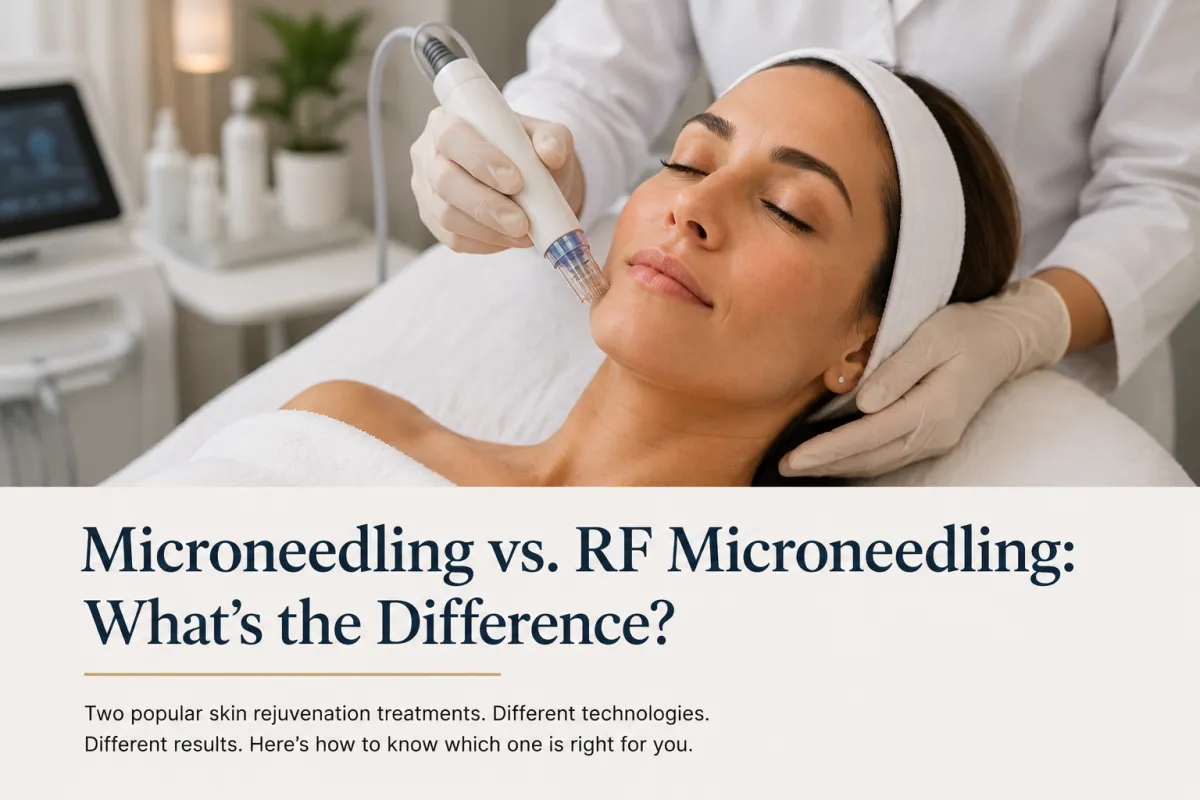
Microneedling vs. RF Microneedling: What’s the Difference? | AdoreU
Microneedling vs. RF Microneedling: What’s the Difference?
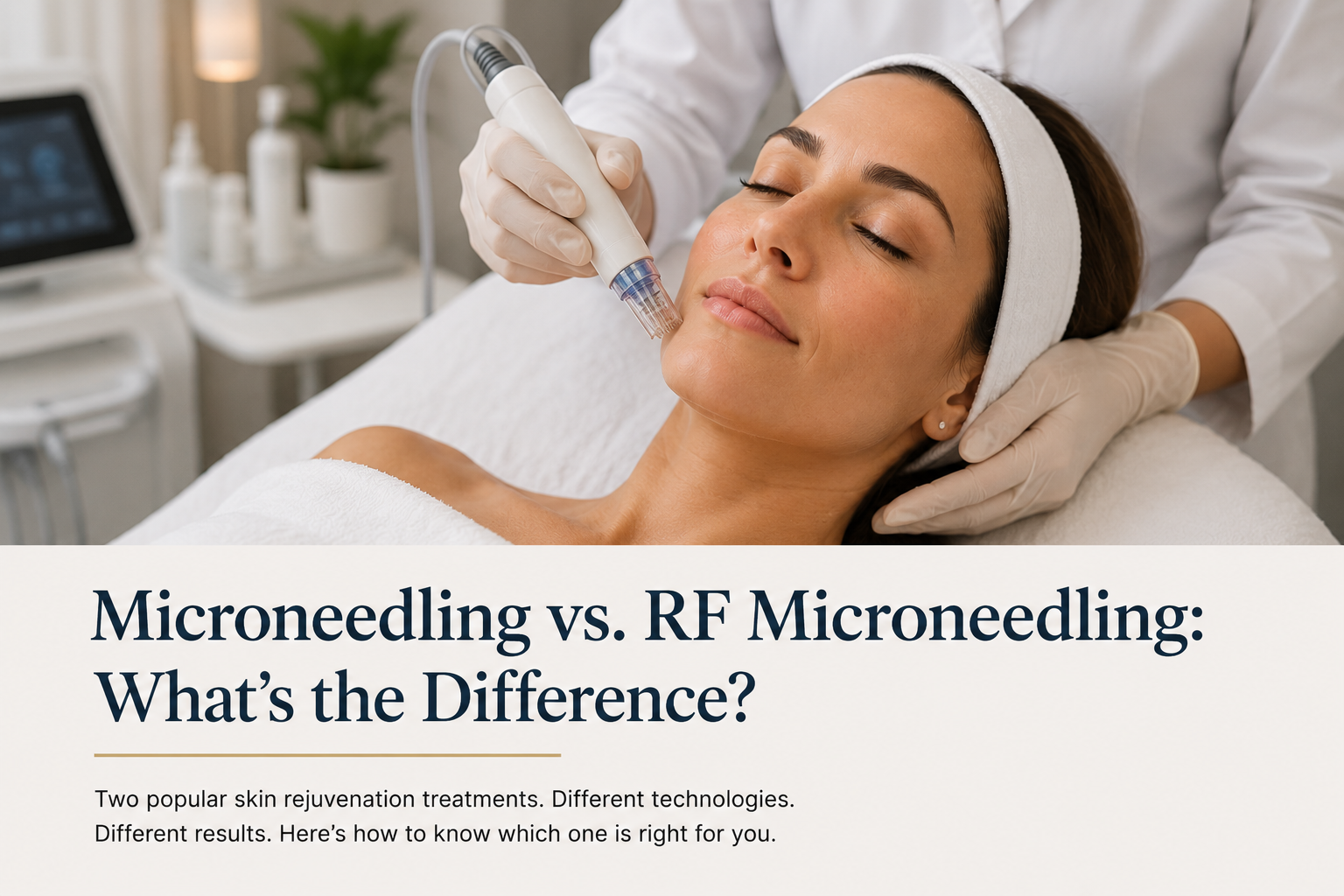
Microneedling and radiofrequency microneedling are often talked about as though they are basically the same treatment.
They’re not.
Both use tiny needles to create controlled micro-injuries in the skin and stimulate the body’s natural repair response. But RF microneedling adds radiofrequency energy beneath the skin, which changes both the depth and intensity of the treatment.
That doesn’t automatically make RF microneedling “better.”
It means the two treatments are useful for different goals.
At AdoreU, I don’t choose a treatment because it sounds more aggressive or because it is the newest technology. I look at your skin, what you want to improve, how much correction you need, and how much downtime you are comfortable with.
The right treatment is the one that makes sense for your skin.
What Is Traditional Microneedling?
Traditional microneedling uses very small sterile needles to create controlled microscopic channels in the skin.
Those tiny injuries stimulate the skin’s natural wound-healing response and encourage collagen and elastin remodeling over time.
Microneedling can be a great option when the goal is improving overall skin quality without a more aggressive resurfacing treatment.
It may be considered for concerns such as:
Uneven skin texture
Enlarged-looking pores
Fine lines
Mild acne scarring
Mild textural irregularities
Overall skin smoothness and quality
One of the things I like about traditional microneedling is that we can stimulate collagen without relying on heat.
For the right patient, it can be a very effective treatment without trying to do more than the skin actually needs.
What Is RF Microneedling?
RF microneedling combines microneedling with radiofrequency energy delivered beneath the surface of the skin.
The needles create the controlled micro-injuries, while radiofrequency energy creates controlled heat within the tissue at selected depths.
That additional thermal energy allows us to target deeper tissue and stimulate a more intensive remodeling response.
RF microneedling may be a better option when the goals include:
More significant textural changes
Deeper acne scarring
Skin laxity
Crepey skin
More advanced collagen remodeling
Areas where deeper tissue tightening or remodeling is desired
At AdoreU, I use RF technology when I believe the additional depth and energy actually serve the treatment goal.
Is RF Microneedling Better Than Regular Microneedling?
Not necessarily.
This is one of the biggest misconceptions in aesthetics.
More aggressive does not automatically mean better.
If you have relatively mild texture, enlarged-looking pores, early fine lines or mild scarring, traditional microneedling may provide exactly the type of collagen stimulation you need.
If we are trying to improve deeper scars, laxity or more substantial textural changes, adding radiofrequency energy may make more sense.
There are also situations where neither treatment is the best choice.
If the main concern is significant sun damage, deeper wrinkles or more advanced resurfacing needs, a laser treatment may give us a better tool for the job.
That is why I prefer to start with the concern instead of starting with a device.
Which Is Better for Acne Scars?
Both traditional microneedling and RF microneedling can be useful in an acne-scar treatment plan.
But acne scars are not all the same.
Someone with relatively superficial textural irregularities may do very well with traditional microneedling.
Deeper scars may require more aggressive collagen remodeling, making RF microneedling a stronger option.
The type of scar matters too.
Rolling scars, boxcar scars, ice-pick scars and discoloration left behind after acne are different concerns and may not respond to the same treatment.
Sometimes the best acne-scar plan involves more than one modality.
This is one reason I don’t automatically recommend the exact same package to everyone who tells me they have acne scars.
Which Is Better for Skin Laxity?
If skin laxity is one of the main concerns, RF microneedling generally has an advantage because of the radiofrequency energy delivered beneath the skin.
That controlled heat can create a deeper tissue response than traditional microneedling alone.
Traditional microneedling can improve overall skin quality and texture, but it does not create the same deeper thermal effect.
So if the goal is primarily skin tightening or deeper collagen remodeling, RF microneedling may be the more appropriate choice.
What About Fine Lines and Texture?
This is where both treatments can be useful.
Traditional microneedling may be enough for:
Early fine lines
Mild texture changes
Enlarged-looking pores
General collagen support
Overall skin quality
RF microneedling may be considered when those concerns are more significant or are accompanied by laxity or deeper scarring.
The goal is not to use maximum energy on every face.
The goal is to use enough treatment to create meaningful improvement without treating more aggressively than necessary.
Does RF Microneedling Have More Downtime?
Usually, RF microneedling is the more intensive treatment.
With traditional microneedling, the skin commonly looks pink or red afterward and may feel warm, tight or mildly sensitive.
RF microneedling can cause more redness, swelling and sensitivity because we are combining needle penetration with radiofrequency energy.
Actual downtime varies depending on:
Treatment intensity
Treatment depth
Treatment area
Your skin
How your individual body heals
This is something we discuss when building your treatment plan.
Some patients prioritize minimal downtime.
Others are comfortable with more recovery if it gives us the ability to address a more significant concern.
What Does Treatment Feel Like?
A topical numbing medication is generally applied before either treatment to make the procedure more comfortable.
With traditional microneedling, patients may feel pressure, vibration or a scratching sensation as the device moves across the skin.
RF microneedling tends to feel more intense because radiofrequency energy is being delivered beneath the skin.
Certain areas of the face can also be more sensitive than others.
Treatment settings can be adjusted according to the area, the concern we are treating and the treatment plan we have established.
How Many Treatments Will I Need?
There is no one correct number for everyone.
Your treatment plan depends on:
Your starting skin condition
What you want to improve
The severity of scarring or texture
The presence of laxity
Your age and skin quality
Previous treatments
How your skin responds
How much correction you want
Someone looking for general collagen maintenance does not necessarily need the same treatment plan as someone trying to improve deeper acne scars.
Collagen remodeling also happens gradually.
You are not seeing the complete treatment response the day the redness disappears.
Microneedling vs. Laser Resurfacing
Sometimes the bigger question is not microneedling vs. RF microneedling.
It is:
Do we need microneedling at all — or would laser resurfacing make more sense?
Laser treatments can be particularly useful when we are trying to address concerns such as:
Significant sun damage
Pigmentation
Deeper wrinkles
More advanced texture changes
More substantial resurfacing
Treatments such as Pearl or Pearl Fractional work differently than microneedling and may allow us to address concerns that need more resurfacing rather than primarily collagen stimulation.
Sometimes traditional microneedling is enough.
Sometimes RF microneedling is the better choice.
Sometimes a laser is the better tool.
And sometimes we use different treatments at different points in the plan.
One device does not have to do everything.
Can Microneedling and RF Microneedling Be Combined With Other Treatments?
They can be part of a broader aesthetic plan when appropriate.
Depending on your goals, your plan may eventually incorporate:
Medical-grade skincare
Other collagen-supporting procedures
But more treatments at the same time do not automatically create better results.
Treatment timing matters.
Skin healing matters.
And each procedure should have a reason for being in the plan.
I would rather sequence treatments intentionally than throw everything at the skin because we can.
How Do I Know Which One I Need?
You do not need to know before your appointment.
That is what the consultation is for.
When I evaluate your skin, I am looking at:
What bothers you most
Your skin texture
Scar type and depth
Laxity
Previous treatments
Desired downtime
Budget
How aggressive you want your treatment plan to be
What is realistically going to move you toward your goal
Sometimes the answer is traditional microneedling.
Sometimes it is RF microneedling.
Sometimes I may recommend a laser instead.
The best treatment is not the one with the fanciest technology. It is the one that makes the most sense for what we are actually trying to improve.
The Bottom Line
Microneedling and RF microneedling both stimulate collagen remodeling, but they do it differently.
Traditional microneedling creates controlled micro-injuries that stimulate the skin’s natural repair process and can be a great option for texture, pores, mild acne scarring, fine lines and overall skin quality.
RF microneedling adds controlled radiofrequency energy beneath the skin, allowing us to treat deeper tissue and potentially address more significant scarring, laxity and textural concerns.
Neither treatment is automatically better.
The right treatment depends on your skin, your goals and how much correction we actually need.
Not Sure Which Treatment Your Skin Needs?
You do not need to choose a device before you come in.
At AdoreU, we start with what you want to improve and build the treatment plan from there.
AdoreU provides individualized aesthetic treatment planning in O’Fallon, Missouri for clients throughout St. Charles County and the surrounding area.